


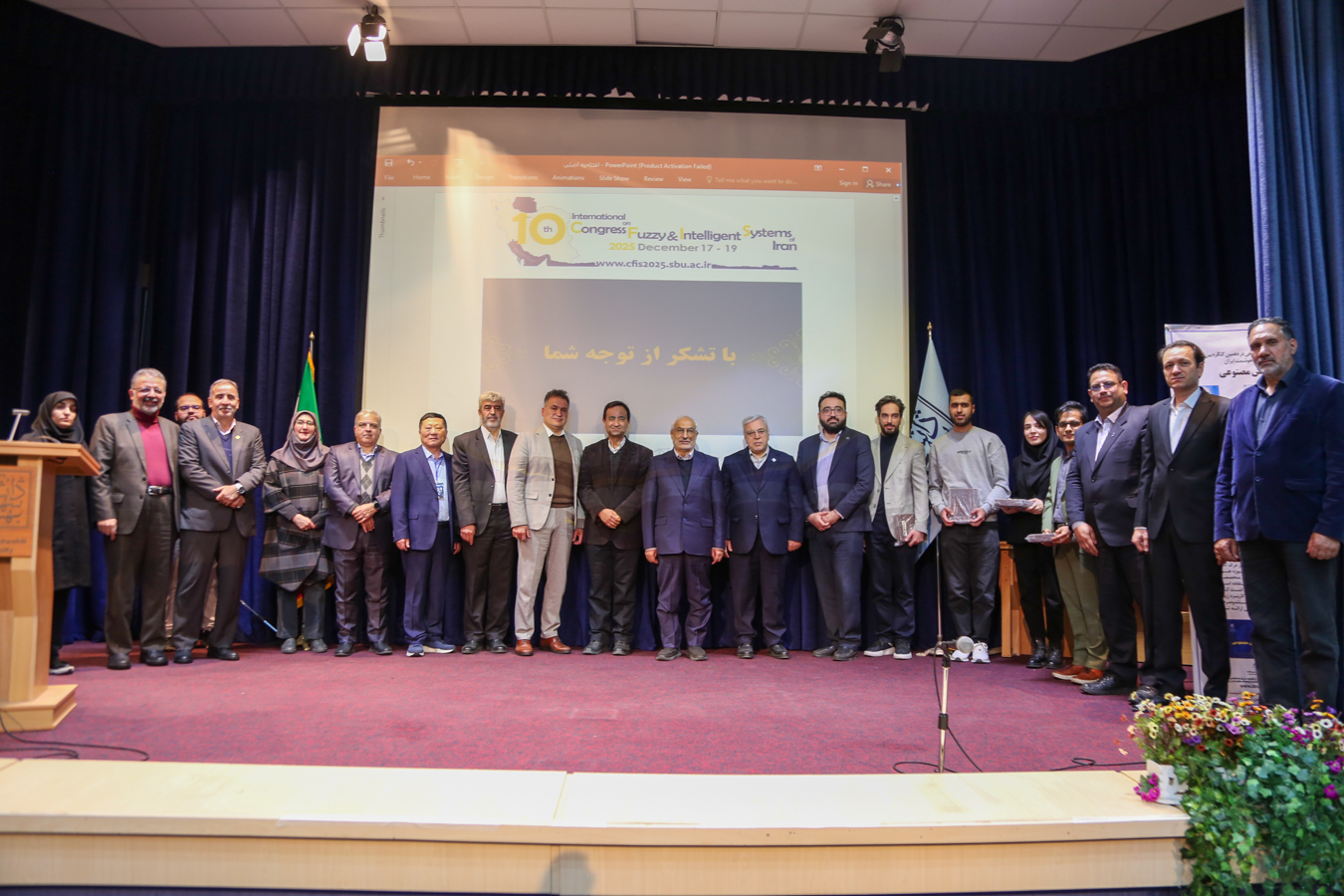
The 10th Joint International Conference on Iranian Fuzzy and Intelligent Systems was held at Shahid Beheshti University with the aim of creating opportunities for dialogue and synergy between academia and industry, and for presenting original research in innovative scientific fields. The event was attended by Dr. Mahmoudreza Aghamiri, President of Shahid Beheshti University, along with domestic and international guests, and a group of professors and faculty members from various universities.
According to the Public Relations Office of Shahid Beheshti University, Dr. Aghamiri, emphasizing the pivotal role of artificial intelligence, fuzzy systems, and intelligent technologies in today’s society, stated: Artificial intelligence is no longer an option; it is an unavoidable necessity. He warned that developing AI without the participation of the humanities can lead to social and cultural harm.
Noting that a university becomes meaningful when its scientific path is networked and interactive, he added that different faculties and disciplines—from engineering and basic sciences to the humanities—must work alongside one another and move away from isolated, siloed approaches.
Referring to the importance of specialized conferences, the President of Shahid Beheshti University stressed that the value of a scientific conference lies in the presence of true experts in the field, even if the number of participants is limited. He reiterated that a successful university is an interdisciplinary one—focused on scientific depth rather than ceremonial formalities.
In another part of the conference, Dr. Mohammad-Mehdi Zahedi, Scientific Secretary of the conference and President of the Iranian Fuzzy Systems Society, honored the memory of the university’s martyrs and the country’s nuclear martyrs and stated: The assassination of scientists will never be an obstacle to Iran’s scientific progress. He added that holding such events demonstrates the continued pursuit of science in the country.
Pointing to the activities of the Iranian Fuzzy Systems Society since 2005, he referred to the society’s affiliated journal as one of the country’s scientific achievements, noting that due to strict academic standards, the journal has rejected more than 90 percent of submitted manuscripts to date.
Presenting statistics on the country’s scientific standing, Dr. Zahedi said that Iran reached third place globally in scientific output in the field of fuzzy systems in 2020 and maintained this position through 2024. However, he noted that in 2025 Iran declined to fourth place—an issue he described as a serious warning for national science policymakers. He also cited the drop in Iran’s overall global scientific output ranking from 15th to 17th, and insufficient research funding, as key challenges in this domain.
Continuing the program, Dr. Mohammad Shahram Moein, President of the Iranian Intelligent Systems Scientific Society, referred to the unveiling of the book “Artificial Intelligence Terminology” and said the publication is the result of collaboration between society members and the Communications Research Center. He added that the society currently has representatives from 40 universities across the country, along with hundreds of faculty members and student members.
He identified the society’s main areas of activity as artificial intelligence, intelligent systems, the Internet of Things, data science, machine learning, and image, video, and audio processing. He also highlighted the organization of conferences, publication of scientific journals, the AI Best Thesis and Dissertation Award, and the activities of the AI working group at the Academy of Persian Language and Literature as other major initiatives of the society.
It is worth noting that the 10th Joint International Conference on Iranian Fuzzy and Intelligent Systems (CFIS2025) is being hosted by the Soft Computing Laboratory of the Faculty of Mathematical Sciences at Shahid Beheshti University, with the support of national scientific associations, the Iranian Fuzzy Systems Society, and the Iranian Intelligent Systems Scientific Society. The conference is scheduled for 26–28 Azar (December 17–19, 2025) at Shahid Beheshti University and includes sessions in both Persian and English in the field of intelligent systems.
Photo Report / The International Conference on Iranian Fuzzy and Intelligent Systems